
|
|
|
Stable Value and GICs
a chapter for the Pension Investment Handbook
V. Investment Characteristics of Stable Value Contracts
Q24 What are the investment risks in a stable value asset? Return to top
The risks of any investment contract vary depending upon the extent of the guarantee provided by the GIC issuer or the synthetic wrap provider. Typically, traditional GICs offer the investor full protection against all the asset risks in the assets backing the contract: credit, call or extension, and income reinvestment. Most also offer protection against any gains or losses on either contribution or withdrawal activity. The investor is dependent upon the creditworthiness of the issuer to deliver this protection.
Most synthetic and separate account GICs, on the other hand, provide a guarantee of principal and accumulated interest, but the plan’s stable value fund participates in gains or losses due to both asset experience through amortized adjustments to the crediting rate. Thus the fund is directly assuming default, call or extension, and reinvestment risk on the portfolio being wrapped. Any experience on plan withdrawals or new contributions is generally also passed through to the fund on a synthetic or separate account. Because the return depends upon the performance of the underlying assets, there is also some uncertainty about the future performance of the asset manager. If there is no maturity on the product, the purchaser also incurs a risk of needing to terminate when market values are depressed. Table 3 below outlines the basic risks in stable value assets and the risk-bearer in the most typical contracts.
Table 3
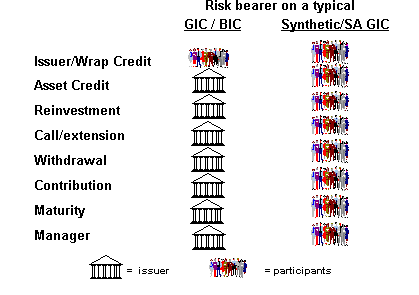
Any time the stable value fund self-insures or assumes an investment risk itself, it should be compensated through a somewhat higher expected return on the investment contract purchased.
Q25 What are the investment characteristics of GICs and other stable value investment contracts? Return to top
Stable value investment contracts may be negotiated with a wide variety of investment and interest-crediting features. The standard traditional GIC or BIC is a zero-coupon investment that earns an annual effective rate paid at maturity, usually three to five years. The issuer assumes all the investment risk on the underlying assets, and any contribution and withdrawal risk assumed in the contract negotiated (see Q15). However, there are a wide variety of other interest-rate crediting options available for stable value contracts.
1. Participating or experience-rated contract: In this type of contract, the crediting rate is reset periodically - usually quarterly or annually - to reflect experience on the contract. In order for the contract to receive book value accounting treatment, the GIC or wrap issuer must ensure that the crediting rate may not become negative. In some instances a minimum or floor rate above zero is guaranteed. Contracts may participate only in the asset experience or in both the asset experience and plan cash flow or liability risks. With this type of contract, the stable value fund self-insures risks.
2. Floating-rate contract: This type of contract provides a credited rate that floats relative to a pre-determined market rate, usually one with a relatively short duration. This type of contract is very attractive to help keep the stable value fund’s crediting rate in line with market rates. Many plans use floating rate contracts to provide liquidity for their stable value fund. Most floating-rate contracts do not have a set maturity date but provide that the contract may be terminated at book value with thirty to ninety days’ notice.
3. Evergreen or constant duration contract: An evergreen contract is one without a pre-determined maturity in which the asset portfolio is managed to a targeted duration. Evergreen contracts are usually actively-managed synthetic (see Q 7) and separate account GICs (see Q12) in which the fund is investing in a specific fixed income investment portfolio, either commingled or established specifically for the fund. Most evergreen contracts are fully participating for both asset and liability risks. The investor should choose an investment style designed to keep the crediting rate stable and avoid excessively long durations if there is substantial potential for participant withdrawals, since losses on those withdrawals will be passed on to remaining participants through lower crediting rates.
Evergreen contracts can be terminated at market value and most can be terminated at book following a multi-year notice period. During this period the portfolio is reinvested in shorter - and typically lower-yielding - assets which mature near the agreed upon date. In a period of rising interest rates, it will be difficult if not impossible to terminate this type of contract quickly without suffering some market value losses.
Evergreen contracts typically quote an initially higher rate than others of similar duration with a stated maturity. This is because the ongoing asset management allows the asset manager to continue to reinvest in instruments close to the original duration, rather than reinvesting in shorter instruments as the contract ages. The difference in yields is analogous to that between yield to maturity and the spot rate on an investment. It will be largest when the yield curve is steep and may disappear altogether when the curve is flat. This differential is compensation for the termination risk on the contract.
4. Alpha GIC: An alpha GIC is a synthetic or separate account GIC coupled with an interest rate swap. The underlying asset portfolio is typically a fixed income fund managed to exceed a specified index or benchmark. In addition to the asset management and wrap agreements, the plan sponsor enters into an interest rate swap in which the stable value fund pays a yield equivalent to the benchmark and, in return, receives a fixed rate for a specified period. If the asset manager performs as expected, the fund receives the fixed rate plus the manager’s "alpha" on the portfolio.
These arrangements offer investors the positive return benefits of active management with less rate volatility than in many synthetic and separate account products. There is also a fixed maturity inherent in the swap agreement. Alphas GICs quote the highest expected return when the swap yield curve moves favorably relative to corporate curve. One drawback is that interest rate swaps have low liquidity and may be difficult to sell if the plan needed the funds. Also, those swaps incorporating the most typical fixed income benchmarks tend to be expensive and thinly traded. This product is much discussed, but its complexity, potential liquidity problems and high fee structure have limited the volume issued to date.

